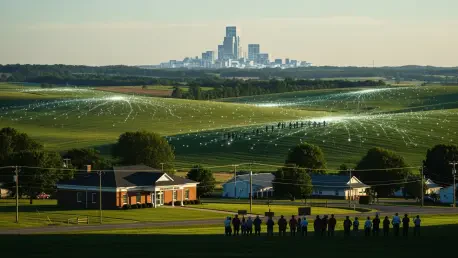

The rolling hills of Franklin County, Missouri, have become an unlikely flashpoint where a century-old community bank finds itself trapped between its agricultural roots and the insatiable infrastructure demands of the artificial intelligence revolution, sparking a controversy that threatens to dissolve decades of local trust. This tranquil landscape, located just outside the urban reach of St. Louis, is now the staging ground for a modern ideological war. At the center of the storm is the Bank of Washington, a $1.2 billion-asset institution that has long served as a pillar of regional stability. The sudden eruption of conflict followed the announcement of the “Gateway Digital Campus,” a massive industrial project intended for a site known as Diamond Farms. While the bank is not the entity developing the land, the acreage is owned by the Eckelkamp family. Because the family has held the reins of the bank for generations, the community has struggled to distinguish between the family’s private land deals and the bank’s corporate responsibility. This overlap has effectively blurred the lines between private wealth and public trust, placing the bank’s reputation under intense siege.
The unfolding timeline demonstrates how a routine real estate transaction can rapidly transform into a nationwide case study on reputational risk. It highlights the friction that occurs when the physical infrastructure required for artificial intelligence (AI) and global cloud computing encroaches upon rural traditions. Understanding this progression is vital in an era where community banks are increasingly judged not just by their balance sheets, but by the perceived societal and environmental impacts of their leadership’s private ventures.
The Intersection of Legacy Banking and the Digital Frontier
The Bank of Washington has historically functioned as the heartbeat of Franklin County, but the proposal for the Gateway Digital Campus has shifted that perception from partner to adversary. The project is slated to occupy 644 acres of rural land, a footprint that residents argue will forever alter the character of their home. For the Eckelkamp family, the land sale represents a private business decision; however, for the bank’s depositors, it is seen as a betrayal of the pastoral values the institution once championed. This tension reveals a new reality for legacy banking: in a hyper-connected world, the “private” dealings of a CEO can directly impact the “public” liquidity of the institution they lead. The digital frontier is no longer a distant concept; it is a physical force that demands land, power, and water, often at the expense of the very communities that local banks are sworn to serve.
Chronology of a Community Conflict: From Rezoning to Resistance
Early 2026: The Gateway Digital Campus Proposal Surfaces
The conflict began in the early months of 2026 when Provident Data Centers, a developer based in Texas, entered into a contract to purchase the sprawling Diamond Farms property from the Eckelkamp family. The ambitious plan aimed to create a high-tech hub designed to support the burgeoning needs of artificial intelligence, cryptocurrency mining, and global cloud storage. However, the project was initially shrouded in secrecy, which fueled immediate resentment. Many residents claimed they only learned of the massive industrial shift through vague postcards sent just days before critical regulatory hearings. This perceived lack of transparency immediately seeded a culture of mistrust between the town and its most prominent family, setting the stage for a protracted battle over the future of the county’s resources.
March 2026: The Rise of Digital Protest Art
By March, as news of the project spread, the opposition moved into the digital realm to capture public attention. A surreal, AI-generated image appeared on Google Maps, depicting L.B. Eckelkamp Jr., CEO of the Bank of Washington, riding a flaming cybernetic horse across a scorched pasture. This piece of digital protest art became a viral symbol of the community’s deepest fear: the destruction of their pastoral lifestyle by the very technology the data center aimed to house. Protesters used AI to satirize the man facilitating the AI infrastructure, establishing a narrative of irony and betrayal. This viral image did more than just mock a local leader; it transformed a local zoning dispute into a symbolic struggle against the perceived coldness of industrial automation and technological overreach.
April 2026: Marathon Hearings and Regulatory Approval
Tensions reached a boiling point during a public hearing held at a local high school gym in April. The meeting was attended by over 850 residents and lasted until the early hours of the morning, as citizen after citizen voiced concerns over noise, water usage, and energy demands. The atmosphere was electric with frustration as farmers and homeowners spoke about the potential depletion of local utility resources. Despite the overwhelming public outcry and the hours of testimony, the Franklin County Planning and Zoning Commission voted 8-1 to approve the rezoning of Diamond Farms. This legislative victory for the developers served as a secondary catalyst for the opposition, shifting the community’s focus from the local regulatory board to a more direct form of economic warfare: the bank boycott.
Mid-2026: The Financial Activism Movement Gains Momentum
Following the zoning approval, grassroots organizers began targeting the Bank of Washington’s deposit base through the Facebook group “No AI Data Centers in Franklin County.” Residents like Amanda Tello publicly closed their accounts, framing the act as a moral imperative to protect the environment and local resources. Protesters argued that if the Eckelkamp family stood to profit from a project that they believed would harm the community, the community should retaliate by withdrawing the capital that fuels the family’s bank. The bank boycott became a strategic tool designed to exert pressure where it would be felt most—the institution’s liquidity and its standing as a community-focused lender. This movement turned every checking and savings account into a political statement, forcing the bank to confront the reality that its financial health was tied to its perceived social license.
Analyzing the Turning Points and Shifting Industry Standards
The most significant turning point in this saga was the transition from traditional environmental advocacy to targeted financial activism. While many industrial projects face local pushback, the direct link to a community bank provided protesters with a unique and powerful leverage point. This event underscores a growing pattern in the United States where the “quiet” development of high-tech infrastructure is no longer a viable strategy for corporations. The shift from digital complaints to physical account closures marks a new era of consumer behavior, where corporate values and the private actions of executives are scrutinized as heavily as interest rates or service fees.
Furthermore, the involvement of major environmental groups like the Sierra Club highlights a broader trend: the scrutiny of data centers as major polluters. The project’s reliance on the nearby Labadie Power Station—a massive coal plant—linked the high-tech future of AI directly to the carbon-heavy past of fossil fuels. This conflict reveals a notable gap in how developers and local governments communicate the “green” credentials of data centers versus their actual impact on local utility grids and water tables. Industry standards are shifting, and stakeholders now demand a comprehensive accounting of how these massive server farms will affect the sustainability of the regions they occupy.
Regional Nuances and the Future of High-Tech Infrastructure
The situation in Missouri is not an isolated incident but rather a microcosm of a national flashpoint. From California to Maine, local governments are grappling with the physical footprint of the digital revolution. In Franklin County, the regional nuance lies in the deep-seated history of the Bank of Washington; the institution’s 150-year legacy, which once served as its greatest strength, became its biggest liability when the community felt that legacy was being traded for corporate profit. The intimacy of small-town banking meant that the land deal was not viewed as a distant corporate transaction, but as a personal affront to the neighbors who had trusted the bank with their life savings.
Expert opinions in the banking sector suggest that this case will lead to new methodologies in reputational risk management for community lenders. A common misconception among executives is that a CEO’s private land deals can be completely decoupled from their professional role in a small town. As the global demand for AI grows, more banks may find themselves in the crosshairs of similar disputes. The Gateway Digital Campus serves as a bellwether, proving that in the modern economy, the success of a technological breakthrough is often dependent on the social license granted by the community it inhabits.
The conflict in Franklin County demonstrated that traditional community support had vanished once the residents perceived a misalignment between the bank leadership’s private ventures and the public interest. Financial institutions learned that maintaining local liquidity required a more proactive approach to environmental and social transparency, as the boycott strategies used by local activists effectively turned banking deposits into a tool for political leverage. Future developments in this sector likely involved stricter state-level oversight of data center resource consumption to prevent similar local upheavals. Researchers found that the “social license to operate” became a primary metric for evaluating the feasibility of high-tech infrastructure projects in rural American corridors. For further exploration of these evolving dynamics, researchers might look into the specific impact of data centers on local water tables or the rising influence of environmental justice movements on small-town municipal zoning laws.