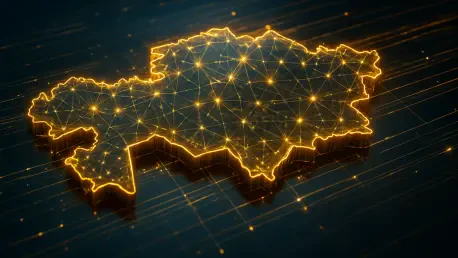

The Evolution of Central Asia’s Digital Financial Powerhouse
The rapid evolution from a cash-heavy economy to a global digital powerhouse has occurred with such intensity that Kazakhstan now serves as a definitive case study for financial technological integration. This transformation has moved beyond simple mobile banking and into a sophisticated ecosystem where a select few dominant banks have managed to absorb e-commerce, public services, and logistics into all-encompassing super-apps. The market has reached a state of extreme digital penetration, making the traditional boundaries between a bank and a technology company almost impossible to distinguish for the average user.
This high level of market concentration has created a unique environment where the consumer experience is seamless but the barriers for new participants are exceptionally high. As the consumer segment approaches a point of saturation, the industry is witnessing a strategic pivot away from closed, proprietary systems toward a shared infrastructure model. This maturation signifies a shift in focus from acquiring individual users to developing robust technological foundations that can support a broader range of financial activities and regional expansion.
Strategic Transitions in Market Dynamics and Growth
Emerging Trends Reshaping the Financial Landscape
The most significant catalyst currently driving the industry is the massive shift from business-to-consumer services toward business-to-business innovation. While the early years of the digital revolution were defined by the race to build the most popular user app, the current focus is on Banking-as-a-Service and embedded finance. This allows non-financial brands to offer sophisticated banking products by plugging into the existing licensed infrastructure of established banks. This utilization of banking licenses as a utility is opening up new revenue streams for incumbent institutions while allowing niche players to flourish without the burden of heavy regulatory overhead.
Moreover, there is a visible move toward the democratization of payment technology through standardized protocols. The era where a merchant had to display multiple QR codes for different banks is coming to an end as interoperability becomes the new standard. This transition is forcing banks to move away from competing on the basis of their private payment networks and instead focus on providing superior value-added services such as advanced credit scoring, personalized loyalty programs, and integrated business management tools for small and medium enterprises.
Performance Indicators and the 2026 Growth Outlook
Current data indicates that the cashless revolution is nearing its peak, with non-cash transactions projected to reach 88% by the end of 2026. This surge is primarily fueled by the explosive growth of QR-based payments, which have doubled their market share over the past two years, effectively replacing traditional card-swiping methods in both urban and rural areas. While the volume of digital activity remains at record highs, the venture capital landscape is experiencing a period of necessary recalibration. Funding for fintech startups has moved from a peak of $32 million in 2023 to approximately $8 million as investors shift their focus from scaling broad consumer apps to supporting early-stage infrastructure and deep-tech projects.
Despite the cooling of traditional venture capital, the digital asset sector is showing remarkable resilience and growth. Transactions involving digital assets through the Astana International Financial Centre have topped $10.6 billion, signaling that the market is ready for a more institutionalized approach to crypto-finance. This growth is being supported by a clear regulatory framework that encourages the use of regulated stablecoins and the integration of digital assets into the broader banking system. The focus for the period from 2026 to 2028 is expected to remain on the refinement of these digital asset rails to facilitate more efficient cross-border trade.
Structural Hurdles and the Path to Interoperability
The primary challenge facing the Kazakhstani fintech sector is the high level of market concentration, with five major banks controlling nearly 70% of all financial assets. This dominance creates a “walled garden” effect, where it is difficult for independent startups to gain traction without the patronage of a major incumbent. Such a structure can stifle genuine innovation if the dominant players choose to protect their market share rather than collaborate. Furthermore, the rapid move to digital platforms has naturally attracted an increase in sophisticated cybercrime and fraud, requiring a more unified and robust national defense strategy.
To overcome these structural bottlenecks, the industry is moving aggressively toward the implementation of Open Banking standards. By mandating the use of Open APIs, the regulator is ensuring that financial data can flow securely between different institutions, allowing smaller fintechs to build innovative products on top of the established banks’ data. This transition is essential for creating a truly competitive landscape where the quality of the service matters more than the size of the bank’s balance sheet. Breaking down these silos is the only way to ensure that the next wave of innovation is not limited to the research and development departments of the largest institutions.
Modernizing the Regulatory Framework and Digital Tenge
The National Bank of Kazakhstan is currently leading a comprehensive modernization of the country’s financial architecture, which many experts consider the most significant regulatory overhaul in decades. Central to this strategy is the rollout of a full-stack digital infrastructure that includes the National Anti-Fraud Center and a unified interbank QR system. These projects are designed to create a level playing field where all participants can operate within a secure and standardized environment. The goal is to move away from a fragmented system of proprietary solutions toward a national utility that benefits the entire economy.
A cornerstone of this new regulatory era is the introduction of the Digital Tenge, a central bank digital currency that is already beginning to change how government and private transactions are handled. The Digital Tenge allows for the creation of programmable payments, which ensures that government social payments or infrastructure funds are used exactly as intended. This level of transparency and efficiency is not possible with traditional currency and represents a major leap forward in the digitalization of the state. By integrating this digital currency with existing payment rails, Kazakhstan is positioning itself as a leader in the global movement toward central bank digital currencies.
Future Horizons: Tokenization and the Open API Era
The next frontier for the market lies in the tokenization of real-world assets and the full realization of the Open API economy. Kazakhstan has already put in place a comprehensive 65-measure plan to attract international capital by allowing for the digital representation of commodities, real estate, and other tangible assets on the blockchain. This will allow for more fractional ownership and higher liquidity in markets that were previously difficult for smaller investors to access. The integration of the Astana International Financial Centre with the domestic banking system is crucial for this, as it provides a regulated bridge between traditional finance and the world of decentralized technology.
As the industry moves deeper into the Open API era, the success of a financial institution will depend on its ability to handle big data and deliver hyper-personalized experiences. The infrastructure is becoming a commodity, which means the competitive advantage will shift toward those who can best analyze customer behavior to provide the right product at the exact moment of need. This future will likely see a proliferation of niche financial services that are embedded directly into non-financial platforms, making banking an invisible but essential part of every digital interaction.
Summary of Kazakhstan’s Fintech Maturation and Prospects
The Kazakhstani fintech sector successfully navigated its transition from an early-stage digital adopter to a mature global leader. Stakeholders moved beyond the era of simple mobile banking and embraced a complex ecosystem defined by shared infrastructure and decentralized finance. The industry recognized that the next stage of growth required a shift toward B2B services and the breaking down of proprietary silos through Open Banking protocols. This maturation process ensured that the country remained at the forefront of financial innovation while providing a more stable and inclusive environment for both consumers and businesses.
Regulatory bodies played a pivotal role by introducing the Digital Tenge and establishing a national framework for digital assets. These steps provided the necessary legal certainty to attract significant institutional interest and fostered a culture of collaborative competition. The focus shifted from merely increasing the volume of transactions to improving the quality and security of the financial experience. As the market entered this new phase, the successful integration of real-world asset tokenization and embedded finance set the stage for Kazakhstan to act as a regional hub for the digital economy for years to come. Moving forward, the industry prioritized the expansion of these technologies to ensure long-term resilience and global connectivity.