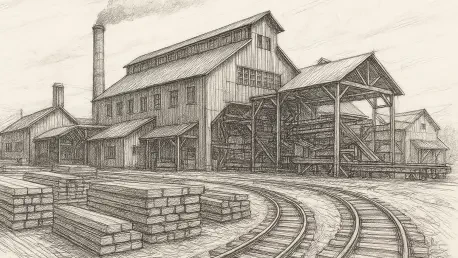

The silent hum of high-precision scanners and the rapid-fire movement of automated carriage systems are quickly replacing the manual labor and legacy machinery that once defined the rugged identity of Northern New England’s timber industry. The lumber market in 2026 has entered a period of relative stability following several years of volatility, serving as a critical pillar for a domestic economy that remains hungry for sustainable building materials. Across the region, the industry is experiencing a profound shift as traditional operations are forced to adapt or decline in the face of evolving global demands.
Northern New England has long served as the heart of the American timber industry, with Maine specifically providing the raw materials that built the expansive suburbs and urban centers of the Eastern Seaboard. This historical significance is not merely a matter of nostalgia; it represents a deep-seated institutional knowledge and a workforce that understands the unique properties of the northern forest. However, maintaining this legacy requires more than just heritage, as the industry now faces the necessity of industrial modernization to remain a viable economic force.
Technological advancements have fundamentally transformed the traditional sawmill into a high-tech manufacturing facility where artificial intelligence and computer-controlled milling equipment maximize the yield of every log. These modern mills utilize advanced scanning technology to detect internal defects and determine the optimal cutting pattern in milliseconds, a process that significantly reduces waste and increases the efficiency of the entire operation. This transition toward a digital-first approach in the woods and the mill is essential for ensuring that the industry can compete with international suppliers.
The role of dimensional lumber in the New England construction supply chain cannot be overstated, as it remains the primary framing material for residential and light commercial development. As architects and developers increasingly seek ways to lower the carbon footprint of new structures, the demand for wood products has grown due to their ability to sequester carbon. Locally produced lumber reduces the environmental and financial costs associated with long-distance transportation, making regional mills the preferred partners for sustainable development projects across the Northeast.
Strategic Drivers for Capacity Expansion in Aroostook County
Emerging Trends in Sustainable Building and Industrial Scaling
There is a growing demand for high-quality, domestic building materials that can meet the rigorous performance standards of modern architecture while adhering to environmental certifications. In response, industrial scaling has become a necessity for Maine manufacturers who wish to maintain a competitive edge against large-scale operations in Canada and the Southern United States. This trend toward industrial modernization allows mills to produce a consistent volume of standardized products that are essential for the large-scale housing projects currently underway across the region.
The preference for locally sourced wood products among contractors and retail consumers has intensified as awareness of supply chain fragility has increased. By sourcing lumber from within the regional ecosystem, builders can avoid the disruptions that often plague international trade routes. This shift in consumer preference has provided a strong incentive for companies like Irving Forest Products to invest heavily in their existing facilities, ensuring they can supply the specific grades and dimensions required by the local market without relying on external imports.
Market Projections and Industrial Growth Indicators
The expansion at the Ashland Sawmill represents a monumental shift in production capacity, with output projected to increase by 92% as the facility moves from 130 million to 250 million board feet annually. This growth indicator signals a robust confidence in the long-term demand for spruce and fir products, which are the primary species processed in Aroostook County. By nearly doubling its capacity, the mill is positioning itself as one of the largest and most efficient producers of dimensional lumber in the entire country.
Maine’s role as a premier manufacturer is further bolstered by the integration of modernized rail services and improved logistics networks that facilitate the movement of massive quantities of lumber. Forward-looking perspectives suggest that the ability to move products efficiently from the rural north to the high-demand centers of southern New England will be the deciding factor in regional industrial success. The 2026 production targets are supported by these infrastructure improvements, which allow for a seamless flow of goods from the sawmill to the construction site.
Overcoming the Economic Hurdles of Rural Industrialization
Addressing the high capital costs associated with modernization in distressed or rural regions requires a sophisticated approach to project finance and risk management. The investment required to install world-class scanning and milling technology often exceeds $100 million, a figure that can be difficult to justify in areas with low population density and limited infrastructure. These regions often lack the traditional capital markets found in urban centers, making it necessary for industrial leaders to seek out specialized financial vehicles to realize their expansion goals.
Navigating the complexities of financing massive infrastructure projects in Nashville Plantation and surrounding areas involves a delicate balance of debt, equity, and government incentives. The geographic isolation of Northern Maine poses unique challenges for logistics and workforce recruitment, which in turn affects the perceived risk for traditional lenders. To bridge these funding gaps, collaborative financial partnerships have become the standard, bringing together commercial banks, community development entities, and state agencies to share the risk and the rewards of industrial revitalization.
Localized production is a key strategy for mitigating the risks associated with global supply chain instability and volatile transportation costs. By concentrating the entire value chain—from sustainable harvesting to final milling—within a specific geographic area, companies can shield themselves from external shocks. This stabilization of the supply chain also provides a more predictable environment for the workforce, ensuring that the jobs created by these massive investments remain secure even when global markets experience turbulence.
Navigating the Regulatory Landscape and Financial Incentives
The Federal New Markets Tax Credit program has proven to be the most pivotal tool for driving large-scale private investment into rural Maine. This program incentivizes corporate entities like TD Bank to provide capital for projects that offer significant socio-economic benefits to underserved communities. Without these credits, the gap between the cost of modernization and the expected return on investment would often be too wide to bridge, leaving many rural facilities to face eventual obsolescence.
Compliance and administrative oversight for these programs are handled by the Finance Authority of Maine, which ensures that every dollar of investment is directed toward projects that maximize job creation and economic stability. The rigorous requirements of the Maine New Markets Capital Investment Program demand that participating businesses demonstrate a long-term commitment to the region. This synergy between state and federal tax credit programs creates a powerful catalyst for private investment, transforming the financial landscape for legacy industries.
Political advocacy has also played a crucial role in securing the modern infrastructure and rail services necessary for industrial growth. Leaders at both the state and federal levels have recognized that a thriving timber industry is essential for the health of the overall Maine economy. By advocating for transportation grants and regulatory frameworks that support forest products, these officials have helped create an environment where a $112.9 million investment is not only possible but sustainable over the long term.
The Future of Rural Economies and Technological Innovation
Advanced manufacturing is fundamentally redefining the “Living Wage” standard by introducing high-skilled, tech-oriented roles into the rural landscape. These positions require specialized training in robotics, data analysis, and industrial engineering, moving the workforce away from purely manual labor. By offering comprehensive benefits and competitive salaries, the modernized sawmill provides a level of economic security that was previously difficult to find in Aroostook County, allowing families to remain in their communities while pursuing modern career paths.
The ripple effect of a major industrial investment extends far beyond the walls of the sawmill, providing a steady demand for the services of foresters, loggers, and transportation providers. When a mill doubles its capacity, it creates a corresponding increase in activity throughout the entire forest products value chain. This interconnectedness ensures that the economic benefits are distributed across the region, supporting small businesses and independent contractors who rely on the primary industry for their livelihoods.
Future growth areas for the Maine timber ecosystem are likely to focus on the integration of digital supply chains and the expansion of sustainable forestry practices. As technology continues to evolve, the ability to track a piece of lumber from its origin in a managed forest to its final installation in a building will become a standard requirement for many developers. This level of transparency and efficiency will further distinguish Maine’s forest products in a crowded market, ensuring that the state remains at the forefront of industrial innovation.
Strengthening the Industrial and Social Fabric of Maine
The $112.9 million investment into the expansion of the Ashland Sawmill provided a crucial foundation for the long-term socio-economic health of Nashville Plantation. This capital infusion allowed for the retention and creation of 220 high-quality jobs, each offering the stability of a living wage and robust benefits in a region where such opportunities were historically scarce. The project successfully demonstrated that legacy industries could be revitalized through a combination of technological adoption and strategic financial planning.
Public-private partnerships served as the blueprint for this revitalization, highlighting how the interests of corporate leaders, banking institutions, and government agencies could be aligned to achieve a common goal. This collaborative approach mitigated the inherent risks of rural industrialization and ensured that the benefits of the expansion were felt by the entire community. The successful implementation of the New Markets Tax Credit program in this context established a repeatable model for other distressed regions looking to modernize their industrial bases.
The expansion ultimately reinforced the industrial and social resilience of Maine by anchoring the forest products sector in a world-class facility. By choosing to invest in the future of Aroostook County, the stakeholders involved took a definitive step toward securing the economic viability of the region for decades. The project was not merely about increasing the production of board feet; it was an investment in the people and the heritage of a community that has always found its strength in the woods. Moving forward, the focus shifted toward scaling these digital forestry models to adjacent sectors like bio-refineries and advanced mass timber manufacturing to further diversify the regional economy.