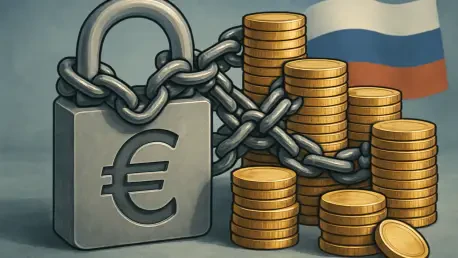

When €140 billion in immobilized Russian central bank assets sits largely at Euroclear in Belgium, the question of what to do with the windfall profits and whether to leverage them for Ukraine stops being a legal abstraction and becomes the EU’s most tangible test of solidarity. Analysts across European institutions describe a plan that could plug Ukraine’s budget and defense gap without new collective borrowing, but only if it survives courtroom scrutiny and market nerves.
Policy advisers argue the stakes are plain: fund Kyiv quickly while preserving legal certainty, investor confidence, and the credibility of sanctions. However, sanctions lawyers warn that the route chosen—profits skimmed versus loans backed by asset flows—will determine exposure to claims and countersanctions. This roundup brings together those competing views as leaders edge toward the December 18–19 summit, where pressure for a compromise is mounting.
Inside the standoff: law, liability, and leverage
Belgium’s red lines: peace terms, precedent, and exposure at Euroclear
Belgian officials and many legal scholars say activating wartime assets before a settlement risks hardening battle lines and preempting reparations negotiations typically handled after hostilities. They argue that breaking with that practice would hand Moscow a propaganda tool and make a peace deal harder, not easier, to land.
Market participants also point to concentration risk: with Euroclear holding the bulk, Belgium could face the densest cluster of suits and retaliation. Financial stability experts caution that a messy legal fight would radiate through collateral chains. In contrast, Commission-minded voices counter that carefully limited measures could be ring-fenced, noting Ukraine’s urgent needs and the political cost of inaction.
Crafting a legal bridge: from windfall profits to loan-backed mechanisms
Central bankers often favor a conservative path—use only the windfall profits generated by the immobilized assets, not the principal—arguing that sovereign immunity and property rights concerns are less likely to be triggered. Sanctions lawyers concede the profits route is sturdier but warn that even this must be designed to avoid de facto expropriation claims.
Fiscal strategists see a second model: monetize future profits to back loans for Ukraine’s budget and defense. They say that a loan framework could deliver scale quickly, but it adds leverage and litigation risk. The Commission’s legal services maintain that targeted, proportionate measures can withstand challenges; nonetheless, investor advocates urge bright-line safeguards to protect market integrity and deter forum shopping.
Sharing the load: G7 coordination and the risk of going it alone
Security analysts argue that a truly collective plan, spread across the EU plus the United States, the United Kingdom, Canada, and Japan, would blunt retaliation risks. With roughly €25 billion in additional EU-held assets and sizeable pools in non-EU jurisdictions, distributed action could dilute any single state’s exposure to countersanctions or seizures abroad.
Trade lawyers warn that unilateral moves invite mirror measures, while a G7-coordinated architecture sets clearer standards and timelines. Diplomats emphasize the bargaining math: alignment on legal rationale, synchronized implementation, and a burden-sharing formula that assigns responsibility in proportion to custodial holdings and fiscal capacity.
Timing the decision: summit politics, Ukraine’s gap, and market signals
Political strategists note that Belgium’s resistance at the last gathering forced a reset, pushing the Commission to refine legal texts ahead of the December summit. The calendar now shapes leverage: delay raises Ukraine’s financing costs and weakens battlefield resilience, but haste risks unforced legal errors.
Market observers read Euroclear’s stability and the broader custodian ecosystem as bellwethers. A measured, clearly communicated plan could reinforce trust in sanctions regimes; a rushed, ambiguous package could chill investment and complicate compliance across banks, funds, and clearinghouses.
What to do next: practical steps to a defensible deal
Across expert communities, three takeaways recur: urgency for Ukraine is real; the legal terrain is unprecedented; and risk must be spread beyond Belgium. The center of gravity tilts toward a narrow, rules-based approach that supports Kyiv while anchoring financial stability.
Policy designers suggest phasing: start with profits-only distributions under strict legal justifications, then consider a capped loan facility if conditions hold. Indemnities for custodians, a compensation fund financed by beneficiaries, and a G7 co-signature would share liability and bolster legitimacy.
Implementation specialists recommend transparent governance, time-bound reviews tied to wartime conditions, and contingency plans for Russian countermeasures. Clear triggers to pause or recalibrate would reassure courts and markets, while standardized reporting would help align EU and G7 oversight.
The road ahead: balancing solidarity, law, and security
Geopolitical analysts see a narrow path that reconciles aid to Ukraine with guardrails for property rights and market order. A coalition-backed framework, meticulously drafted and tightly focused on profits rather than principal, would preserve legal norms while meeting urgent needs.
Looking forward, experts believe the outcome will shape the credibility of sanctions, the duties of asset custodians, and the EU’s crisis-financing playbook. A defensible deal, supported across the G7, could turn a contentious asset freeze into a durable instrument of policy rather than a precedent that haunts future conflicts. For deeper context, readers could explore Commission legal assessments, central bank opinions on sovereign immunity, and think tank analyses of sanctions design and burden-sharing formulas.