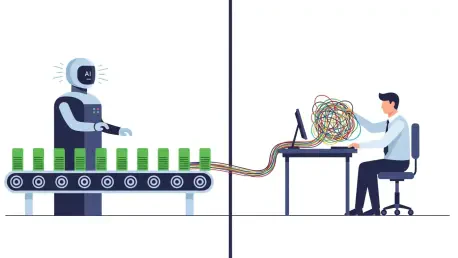

The promise of artificial intelligence in banking was a future where automated systems would handle tedious work, freeing human employees to engage in more strategic and fulfilling endeavors; however, a starkly different reality is beginning to take shape across the financial sector. Instead of liberating the workforce, AI’s proliferation is creating a counterintuitive trend: human jobs are becoming more complex, mentally taxing, and emotionally draining than ever before. This shift is not a temporary adjustment but a fundamental redefinition of the human role in banking.
This emerging dynamic poses a critical threat that extends far beyond individual job descriptions. It challenges employee well-being, risks organizational stability, and forces a reevaluation of the very definition of productivity in the financial world. The silent accumulation of high-intensity tasks on human desks, masked by the high-volume efficiency of machines, creates a fragile system where employee burnout becomes an operational risk.
This analysis will explore the mechanisms behind this trend, examining how AI is systematically hollowing out traditional banking roles and creating a significant “productivity paradox.” Furthermore, it will investigate the potential futures for a workforce increasingly tasked with managing the exceptions, emotions, and errors of sophisticated automated systems, presenting a critical decision point for the industry’s leaders.
The Automation Reality: Reshaping Banking Operations
The integration of AI is no longer a futuristic concept but a present-day operational reality that is profoundly altering the structure of banking. Automation is not merely supplementing human effort; it is actively reshaping job functions from the ground up. This technological overhaul is forcing a clear and often challenging division of labor, where machines handle the predictable, and humans are left to grapple with the unpredictable.
The Hollowing Out of Traditional Banking Roles
The relentless adoption of AI and automation is systematically eliminating the routine and predictable tasks that once formed the bedrock of many banking careers. Standard transactions, procedural data entry, and even basic advisory functions are now largely handled by algorithms, which execute these duties with superior speed and accuracy. This automation of the mundane has stripped away the foundational work that previously occupied the bulk of an employee’s day.
This process is not a simple one-for-one replacement of jobs but a fundamental restructuring of the workforce, creating what is known as the “disappearing middle.” As AI absorbs the intermediate-level tasks, only two extremes remain for human workers: the most basic, client-facing interactions and the most intricate, high-stakes problem-solving. This polarization leaves a gap in the career ladder, making professional progression more difficult and concentrating pressure at the complex end of the spectrum.
The New Human Workload: High Stakes Exception Handling
With routine processes automated, the human workload has pivoted almost exclusively toward managing cases where AI systems have failed. Employees are now the primary responders for complex, non-standard problems that the algorithm could not process or understood incorrectly. This role of failure management requires deep diagnostic skills and the ability to navigate gray areas that fall outside the rigid logic of automated systems.
Moreover, human agents are increasingly becoming the sole resource for handling emotionally charged customer situations where empathy is paramount. Scenarios involving financial fraud, family bereavement, or the distress of digital exclusion require a level of compassion and nuanced communication that AI cannot replicate. This concentration of emotional labor turns every human interaction into a potentially high-stress event, demanding significant psychological resilience from employees.
A core new responsibility for banking professionals is also acting as an AI translator. When an algorithm makes a decision—such as rejecting a loan application—it is often the human employee who must explain this opaque conclusion to a frustrated customer. This task is made profoundly difficult by the fact that the employee often lacks insight into the specific variables and weightings the AI used, forcing them to justify a decision they did not make and cannot fully comprehend.
The Human Cost: A Productivity Paradox
The traditional metrics used to measure employee productivity are rapidly becoming obsolete in this new environment. Banks can now point to skyrocketing transaction volumes and processing speeds as evidence of success, attributing these gains to AI-driven efficiency. However, these top-line figures completely obscure the reality of the human workload, which has become exclusively focused on difficult, time-consuming, and mentally exhaustive cases.
This disconnect creates a dangerous paradox for the modern banking employee. For instance, a fraud investigator who once handled 30 cases of varying difficulty in a day might now manage only 10, all of which are highly complex and require intense critical thinking. According to outdated metrics, their productivity has plummeted, yet their work is harder and more valuable than ever. This discrepancy between perceived and actual performance fosters an environment rife with stress, burnout, and a growing sense of alienation among the very experts the institution relies upon most.
Envisioning the Future Workforce: AI Support Staff or Human Experts
If this trend continues unmanaged, it threatens to transform skilled banking roles into high-stress support functions for artificial intelligence. In this scenario, the job is not to exercise professional judgment but to manage the fallout from algorithmic decisions. The credit officer becomes an “AI Translator,” tasked with justifying algorithmic loan rejections to disappointed applicants. Similarly, the customer service agent evolves into an “Escalation Handler,” a role that involves dealing exclusively with customers whom technology has already failed, making every interaction a negative one. In branches, staff may find themselves acting as “Digital Therapists” for individuals left behind by the digital-first ecosystem.
This trajectory leads to unsustainable job design, creating a workforce of hyper-specialized but perpetually stressed employees. These individuals are simultaneously indispensable for handling AI’s shortcomings and constantly at risk of being made obsolete by the next software update that learns to manage the exceptions they handle. Such a model is not conducive to long-term career development or employee satisfaction.
The industry now faces a critical choice. It can either continue down this path of reactive, high-stress job design or strategically pivot to create roles centered on uniquely human strengths. The central question must shift from “What can’t AI do?” to “What shouldn’t AI do?” By prioritizing roles that require ethical judgment, creative problem-solving, and deep empathy, banks can build a more resilient and collaborative workforce, positioning their human experts as essential partners to technology rather than its support staff.
Conclusion: Redefining Value in the Age of AI
The integration of artificial intelligence into banking did more than just automate tasks; it fundamentally altered the nature of human work, creating a more complex and emotionally demanding environment under the guise of greater efficiency. The evidence showed that while machines handled volume, humans were left with the high-stakes, high-stress exceptions, leading to a workforce that was working harder, not smarter.
Ultimately, the challenge for the banking industry proved to be not technological but ethical and strategic. A failure to address the human impact of AI risked creating a burned-out workforce and eroding the very customer trust that underpins the financial system. The most forward-thinking institutions recognized this paradox early on.
In response, leading banks began to move beyond measuring machine productivity and started to intentionally design human-centric career paths. They invested in training that valued empathy and critical thinking as core competencies, ensuring a sustainable and collaborative future. This strategic shift ensured that their employees remained the institution’s greatest asset, capable of navigating a world where technology and humanity must coexist.