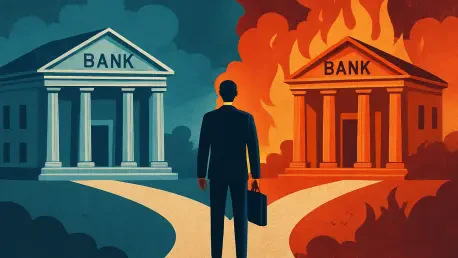

In a decisive move that reverberates through the financial industry, federal regulators have formally dismantled a key piece of post-financial crisis policy, leaving banks to navigate a landscape with newfound freedom and potential peril. The Office of the Comptroller of the Currency (OCC) and the Federal Deposit Insurance Corp. (FDIC) officially withdrew the 2013 leveraged lending guidance, a framework designed to rein in risky corporate lending. This significant regulatory shift is predicated on the argument that the old rules were overly restrictive, pushing lucrative business away from traditional banks and into the less-regulated shadow banking sector. Now, as the guardrails are removed, the banking sector stands at a critical juncture, facing a fundamental question: will this deregulation fuel a new era of economic expansion by leveling the competitive playing field, or does it open the door to excessive risk-taking that could precipitate the next credit downturn?
A New Regulatory Philosophy
The driving force behind this policy reversal was a widely held belief among regulators that the 2013 guidance had inadvertently created market distortions rather than simply mitigating risk. The agencies argued that the framework was not only “overly restrictive” but also “overly broad,” hampering the ability of banks to apply their own sophisticated risk management principles to complex lending situations. A primary and concerning consequence of this rigidity was a significant migration of the leveraged lending market. Regulated banking institutions found themselves losing substantial market share to a burgeoning class of nonbank lenders, including private credit behemoths like Apollo Global Management and Blackstone. This exodus of activity effectively shifted a massive volume of high-risk lending beyond the direct oversight of traditional financial regulators, a development that drew concern from figures such as Treasury Secretary Scott Bessent, who noted the potential for systemic vulnerabilities to build up in these less transparent corners of the financial system.
In place of the specific, prescriptive rules of the past, the new regulatory environment is anchored in a principles-based approach that champions institutional autonomy. Banks are now expected to lean on general standards for prudent risk management as they engage in commercial lending. One of the most critical changes is that each institution is now responsible for formulating its own internal definition of a “leveraged loan” and managing its total exposure in a manner consistent with its board-approved risk appetite. While this grants banks considerable new freedom, regulators have been quick to emphasize that this is not an abdication of their oversight duties. Federal examiners will continue to scrutinize banks’ underwriting standards, risk rating systems, and loan loss reserves. However, this supervision will now be tailored to the unique size, complexity, and risk profile of each bank’s lending portfolio, moving away from a one-size-fits-all model. Regulators still formally advise banks to maintain strong underwriting criteria, rigorously analyze a borrower’s actual performance against projections, and diligently monitor all loans throughout their life cycles.
Dueling Economic Forecasts
The consensus within the financial community is that this regulatory pivot will have a profound and immediate impact on the market, though opinions diverge sharply on whether the net result will be positive. From one perspective, articulated by analysts at JPMorgan Securities, the rescission of the 2013 guidance could act as a powerful catalyst for growth. This view holds that the move will significantly accelerate the expansion of commercial and industrial loan portfolios as banks are finally untethered to compete head-on with private credit firms. This would allow them to reclaim business that had migrated to the nonbank sector and, importantly, provide more financing for non-sponsored transactions—deals not backed by private equity firms—which are a vital source of capital for a wide swath of the economy. The expanded flexibility is expected to trigger a comprehensive reassessment of lending strategies and risk frameworks across the industry, as institutions recalibrate their models to seize new opportunities in a more permissive regulatory environment.
However, a contrasting and more cautious viewpoint raises concerns about the potential long-term consequences of this deregulation. An analyst from RBC Capital Markets, while acknowledging the short-term benefits of a less restrictive environment, issued a warning that captures the central trade-off of this policy shift. While the move is highly likely to spur more rapid loan growth in the immediate future, it could simultaneously sow the seeds for higher credit losses when the next economic downturn inevitably arrives. This perspective suggests that in the rush to regain market share and boost profits, underwriting standards could weaken across the industry, leading to a system-wide buildup of risk. Adding another layer of complexity to the situation is the notable silence from the Federal Reserve, a key agency that was instrumental in issuing the original 2013 guidance. The Fed has not yet commented on the OCC and FDIC’s withdrawal, leaving its position on the matter uncertain and raising questions about regulatory alignment at the highest levels of financial supervision.
Charting a Course in a Deregulated Landscape
The decision to rescind the leveraged lending guidance ultimately represented a fundamental pivot in regulatory philosophy, transferring a significant degree of responsibility from the rulebook to the boardroom. This action marked a deliberate move away from rigid, prescriptive oversight and toward a model that relied on the internal discipline and risk management acumen of individual financial institutions. The long-term success of this deregulatory measure hinged not only on the banking sector’s collective ability to self-govern with prudence but also on the capacity of federal examiners to effectively adapt their supervisory methods to a more nuanced and principles-based framework. It set the stage for a new dynamic where the stability of the financial system became intrinsically linked to the risk culture cultivated within each bank, creating a landscape where the consequences of this newfound freedom would only become fully apparent during the next period of significant economic stress.