
Rob Reilly will transition to executive vice chair and senior advisor after 13 years as CFO, marking the end of a significant chapter in PNC’s financial leadership history. This high-level reorganization serves as the cornerstone for a broader institutional transformation aimed at elevating the firm from its roots as a regional player to a definitive national powerhouse. As the financial sector navigates an environment defined by rapid consolidation and shifting consumer expectations, the institution is doubling down on its super-regional identity by aggressively expanding its physical reach. This strategic pivot is not merely about increasing the number of teller windows but about establishing a permanent and influential presence in the fastest-growing economic corridors across the United States. By synchronizing leadership changes with an ambitious infrastructure build-out, the bank aims to solidify its standing among the elite group of lenders that will define the retail landscape for years to come.
The Geography of Growth: Branching Into the Sunbelt
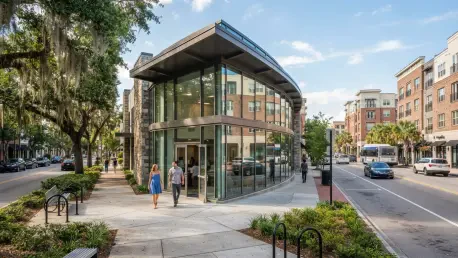
PNC has significantly accelerated its roadmap for physical expansion, identifying the Southeast and Sunbelt regions as the primary battlegrounds for retail dominance. The recent announcement to add 63 new branches to its existing growth pipeline signals a massive capital commitment to markets that are currently experiencing an influx of corporate investment and population growth. Specifically, the bank is focusing on high-potential hubs in South Carolina and Georgia, with 53 locations slated for cities like Charleston, Savannah, and Augusta. This regional concentration is complemented by a broader push across Texas, Florida, and North Carolina, where ten additional branches will be established. By 2031, the institution expects to have completed the construction of approximately 370 new locations nationwide. This expansion is designed to ensure that the bank is not just a digital provider but a visible, tangible neighbor in the communities where its future customers live and work.
CEO Bill Demchak characterizes this aggressive brick-and-mortar build-out as a race for critical share in a landscape that is rapidly approaching a consolidation endgame. In his view, the retail banking industry is moving toward a scenario where only a handful of truly national players will remain viable, making early entry into growth markets a necessity rather than a choice. By targeting vibrant urban centers like Atlanta, Dallas, Charlotte, and Phoenix, the bank is positioning itself to be one of the ultimate winners in this high-stakes competition. While digital banking continues to revolutionize how transactions occur, the physical branch remains a vital tool for capturing new market share and fostering long-term brand loyalty. These locations serve as showrooms for complex financial products and advice centers for small business owners, roles that mobile apps cannot yet fully replicate. The strategy rests on the belief that a physical presence is the ultimate competitive advantage for modern lending.
Strategic Leadership: Aligning Operations With Capital
In tandem with its geographic maneuvers, the bank has initiated a meticulously timed succession plan for its financial leadership to maintain stability during this period of significant change. Alex Overstrom, currently serving as the head of retail banking, is scheduled to assume the role of Chief Financial Officer in March 2027. Overstrom has been a pivotal figure within the organization since 2014 and has led the retail segment through the very expansion efforts that are now making headlines across the financial sector. His promotion is a clear signal that the board values operational experience and a deep understanding of the customer-facing business when managing the firm’s broader financial strategy. By setting a long-term timeline for this transition, the leadership ensures that there will be no disruption in financial oversight as the bank executes its complex national growth plan. This passing of the baton represents a proactive approach to talent management that prioritizes continuity over the risks of external recruitment.
The strategic roadmap established by the leadership provided a clear blueprint for how legacy institutions could successfully adapt to a hyper-competitive national market. It was observed that the integration of retail expertise into financial governance became a model for other firms seeking to bridge the gap between back-office management and customer-facing growth. Investors recognized that the emphasis on physical branch density in high-growth corridors served as a necessary hedge against the commoditization of digital-only banking services. Moving forward, the most effective path for regional banks involved a rigorous assessment of their own internal leadership pipelines to identify individuals who could balance fiscal discipline with an aggressive growth mindset. Prioritizing these internal transitions allowed organizations to maintain stability while navigating the logistical challenges of large-scale expansion. This period of transformation demonstrated that the most resilient banks were those that viewed their physical and human capital as inseparable strategic assets.