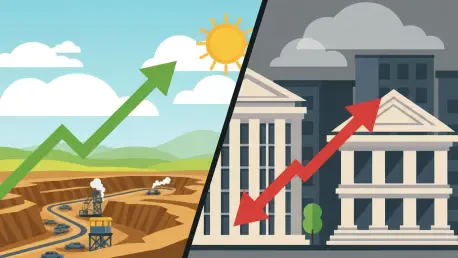

The UK’s benchmark FTSE 100 index experienced a classic tug-of-war on Wednesday, ultimately closing with a marginal 0.1% loss in a session defined by starkly contrasting fortunes. While a powerful rally in mining and defense stocks provided significant upward momentum, this was not enough to overcome the heavy selling pressure that gripped the influential financial sector. This article will dissect the day’s trading, exploring the specific catalysts that drove these divergent trends. By examining the regulatory fears plaguing banks, the commodity boom fueling miners, and the wider economic sentiment, we can gain a clearer understanding of the complex forces currently shaping the UK’s leading stock index.
The Economic Backdrop: Geopolitics and Commodity Cycles Set the Stage
Wednesday’s trading did not occur in a vacuum. It reflects a broader market environment shaped by persistent macroeconomic and geopolitical factors. Investors continue to grapple with shifting expectations around interest rates, global growth, and persistent inflationary pressures. Simultaneously, geopolitical tensions, particularly the ongoing conflict in Ukraine, create an undercurrent of uncertainty that directly impacts sectors like defense and energy. The FTSE 100, with its heavy weighting toward global commodity producers and international banks, is uniquely sensitive to these dynamics. The day’s performance underscores how fluctuations in global commodity prices and domestic regulatory actions can create powerful, yet opposing, currents within the same index.
Dissecting the Day’s Divergence: Winners and Losers
The Banking Sector Under a Regulatory Cloud
The primary drag on the FTSE 100 was a significant 1.7% drop in the heavyweight banking sector. This sharp decline was triggered by an announcement from Britain’s financial regulator, which confirmed it would end its temporary pause on handling motor finance complaints on May 31, nearly two months earlier than planned. The news reignited investor anxiety over the potential scale of compensation related to a historic mis-selling scandal, where consumers were allegedly charged excessively high interest rates on car loans. This regulatory uncertainty hit major lenders hard, with Lloyds Banking Group, Close Brothers, and Barclays all seeing their shares fall. Adding to the sector’s woes, HSBC Holdings slid 1.6% following the unexpected appointment of its interim chair to the permanent CEO role.
Commodity Supercycle Fuels Miner and Energy Rally
In a powerful counter-narrative, soaring commodity prices sent resource stocks surging. The industrial metal miners’ index jumped an impressive 3.3% as copper prices climbed to a new record high, fueled by strong demand signals and supply concerns. Glencore was the session’s standout performer, rocketing 6.3% to a 10-month high after the company issued an optimistic copper production forecast. This bullish sentiment lifted its peers, with Antofagasta and Anglo American posting robust gains of 4.9% and 2.5%, respectively. The positive momentum extended to the energy sector, which advanced 0.7% as oil prices rose, boosting shares in major players like BP by 1.3%.
Geopolitical Tensions and Corporate News Add Complexity
Beyond the two dominant themes, a mix of geopolitical news and company-specific developments added further layers to the market’s performance. The aerospace and defense sector climbed 1.4% after reports emerged that peace negotiations between Russia and U.S. officials concerning Ukraine had failed, increasing the outlook for defense spending and lifting stocks like Rolls-Royce and Babcock International. Conversely, weak economic data, which showed a slowdown in the UK’s vital services sector, soured broader sentiment. This was reflected in losses among consumer staples and a 4.2% drop for Sainsbury’s after its major shareholder, Qatar’s sovereign wealth fund, signaled its intent to reduce its stake.
Navigating Future Volatility: Key Trends to Watch
Looking ahead, the competing forces seen on Wednesday are likely to persist. The motor finance investigation will remain a significant overhang for the UK banking sector, with the ultimate financial impact still largely unknown. This regulatory uncertainty could continue to suppress valuations and create volatility for financial stocks. In contrast, the outlook for mining and energy sectors remains tied to the global economic cycle. Continued demand, particularly from China, coupled with ongoing supply disruptions could sustain high commodity prices, providing a long-term tailwind for the FTSE 100’s resource giants. Investors will also be watching geopolitical hotspots closely, as any escalation could further bolster defense stocks while potentially disrupting global trade.
Investment Insights: Lessons from a Divided Market
The day’s trading offers several key takeaways for investors navigating the UK market. Firstly, it highlights the acute sensitivity of the financial sector to domestic regulatory news, reinforcing the need to monitor policy shifts closely. Secondly, it serves as a potent reminder of the FTSE 100’s significant leverage to the global commodity cycle, where the fortunes of a few large miners can heavily influence the entire index’s direction. For investors, this underscores the importance of a diversified approach. Relying on the index as a monolithic entity is unwise when its largest components are being pulled in opposite directions by fundamentally different economic and political drivers.
Balancing the Scales: The Enduring Tension in the UK Market
In summary, the FTSE 100’s slight decline was a story of a market perfectly balanced on a knife’s edge. The powerful updraft from a global commodity boom was met with an equally forceful downdraft from domestic regulatory fears. This session was a microcosm of the enduring tension within the UK market—a constant interplay between global macroeconomic forces and local pressures. For the foreseeable future, the path of the FTSE 100 will be determined by which of these powerful forces exerts greater influence, demanding vigilance and a nuanced understanding from investors.